Gem from GK Chesterton

"A dead thing can go with the stream, but only a living thing can go against it."

From The Everlasting Man

Thursday, January 15, 2009

New Feature Starting at TSON: Free Comedy Gold From Craig's List

This is waaaaaay off topic, but I just can't resist.  

Most of the stuff advertised on Craig's List "Free Stuff Classifieds" is just stuff.  But some of it is comedy gold!  From time to time I'll post an item that will leave your morning coffee spewed all over your computer screen.  All of these are real classifieds on Craig's List quoted verbatim, but I can't guarantee that any of the free stuff actually exists.  Nor will I vouch for their ability to hold your tanker in place on the high seas.  Which brings me to our inaugural post.


The anchor & chain are in good condition. There are some minor corrosion spots on the surface though. It weighs 14100 kg plus a couple of chain-links each ~350 kg. I cant guaranty the Anchor actually works cause I did not have the chance trying it out, but it is quality work out of Japan and is now sitting in the back of my house. Come and get it out of my yard. 

Self pickup only! 

Please contact me via cl if you are interested.


He's not going to guarantee that your tanker will, in fact, be kept in place by this anchor.   But hey, it's free!  Right now a tight-wad captain of some oil tanker is thinking, "Sure there's a chance it won't work. But, gall dang it, I really need an anchor and I hate spending money on this rust bucket.  I'm getting it!!!!"

Even more funny:  Self pick up only! 

Fifteen bonus points to you if you come up with the best back story for how this anchor got from Japan to this guy's backyard. 

Wednesday, January 14, 2009

The Prophet Douglas Adams and Distributed Computing


If you've read the Hitchhiker's Guide to the Galaxy series, you've read the greatest prophet of the 20th century.    Because within a mere 40 years of writing his first book, Douglas Adams successfully predicted that the earth is a giant computer.  Perhaps not with pan-dimensional creatures who take the form of mice* at the helm.  But he nailed it nonetheless.

Recent advances in distributed computing have proved him right.  I'm not talking about "old fashioned" distributed computing where the processing power of thousands or millions of computers spread across the web are used crunch massive numbers for the SETI@Home project and the like.   Don't get me wrong. That does seem like a single global computer and it comes close to Adamsian fullfillment.  But remember, in Hitchhikers the people themselves were part of the earth computer.

If not SETI, then what?  I'm talking about "Lostpedia" aka The Lost Wikia.  Yes, Kevin Croy's** hugely popular wiki site for fans of the TV show "Lost" is the realization of the fantastic, utterly unrealistic Hitchhikers Guide oracle.  Because a wiki turns people into a distributed computer system***.  

Consider what role "Lostpedia" performs.
  1. A new Lost TV episode "downloads" a data set in the form of character development, plot lines, and often confusing glyphs, codes, hints and clues. 
  2. The data is then processed, analyzed, and crunched by the TV show devotees acting as a collective CPU.
  3. The newly processed information is uploaded from the viewers via the Wikia web page and order arises from disorder.
With SETI@Home, individual computers are tasked to identify signal within the noise of space radio signals to identify extraterrestrial intelligence.  But with Lostpedia, and other wikis like it, the individuals themselves (people!) are acting as a distributed computer system and discerning signal from noise for a TV show.  And what's more intense about this form of distributed computing is that it combines the intelligence and creativity of humans with the brute force, power and blazing speed of digital computers.    An silicorganic distributed computer!

We all thought Douglas Adams was being wacky and zany by suggesting that the earth and it's inhabitant are a computer.  He was being prophetic.

So what does it all mean?  42.


The Fine Print
*At least I really, really hope that mice aren't involved.  Read my "Existential Rodent" post if you don't appreciate my trepidation on this point.

**If this was a reputable journalistic endeavoer I would disclose that Kevin is my cousin.  But since I'm not a journalist I won't disclose this fact. 

***I'm not nearly smart enough to think of this on my own. This post hatched from a conversation with Kevin at my grandparents house.


Tuesday, January 13, 2009

The "You are Here Conundrum"


The gears are still turning after the Large-Scale Structure post.  And since my blog is maxed out on paradoxes for the moment, I'm not calling this a paradox, but the "You are Here Conundrum."  

It's probably Philosophy 101 material (included in the second semester mind/brain mid-term) but I still find the following question to be fascinating and worth some chin scratching.

The conundrum is this:  At what scale do you become "you"?  Or, rephrasing, is it ever possible to point and say with certainty, "You are here"?

Keeping in mind the discussion of pixels and photomosaics , follow me in this thought experiment.  First, look at your finger.  Now look closer...closer...closer!  Look close enough so  that you're on the atomic scale and can see a hydrogen atom within your finger (OK, use a scanning tunneling microscope if your eyesight is poor.  But don't get whiny with me if you don't have an STM.  Remember this is a thought experiment. Just make one.   Also remember I'm not a philosopher, so follow at your risk.)

Alright, so now you're looking at an individual hydrogen atom in your finger.  I ask the question, "Is that atom you?"  Clearly you would say, "No, that's not me, it's just an atom.  I could easily loose that atom and I would still be me."  I would say, "Correct."

Now reverse zoom* a bit and look at the organic molecule which that hydrogen atom is part of.  I ask the same question, "Is that you?"  Certainly not, it's just a molecule.  It's in you but it is not "you".

Reverse zoom to the cellular level.  That single cell is not "you" either. 

Now get rid of the STM, and reverse zoom to the view where you can see your entire finger.  That finger is still not you.  You're starting to feel it is a part of "you", but you could loose that finger in  a vicious opossum attack and still consider that "you" are "you" because "you" are not the finger.  

Now zoom out to where you can see all of you and the people around you in the Starbucks** in which you're now sitting***.  Take a picture of the scene.  Look at the picture and point to yourself.  You are clearly in the cafe.  I can easily say, "You are here" and you would agree.

Here's where the conundrum rears it's ugly (?) head.  Somewhere in between the finger level zoom and the Starbucks level  zoom  "you" become "you".  But where and what is the boundary between you'ness**** and not-you'ness?  

Zeno might be making a cameo again (curse him!) because as you reverse zoom from the atomic scale through microscopic scale to macroscopic scale you first must reverse zoom half way between "not you" and "you".  Then you must reverse zoom half way again from "not you" to "you".   Yet at some point, you cross a boundary and you say, "this physical stuff definitely contains me" and "I am here!"  And I could point and say, "You are here!"

People familiar with mind/brain philosophy will probably pipe up right now and say, "Why not run the experiment starting with a hydrogen atom within the brain instead of the finger? Afterall, that is most likely where your personality resides."  And I say to them, "Excellent idea!  Why didn't I think of that?"  Then they would say, "Because I'm a philosopher and you're not!"  And then I'd hang my head a bit.  Fearing my new conundrum is doomed. [Hey!!! It's not polite to cheer wildly at this point.  Stop it!!  I'm bummed out.  Sheesh why not rub some lemon and salt on that wound while you're at it!] 

But then I throw my chest out in renewed hope, because the same problem exists even if you use the brain as the starting point for your reverse zoom.    Whenever one says, "I am here", I'm going to say, "OK, but let's zoom in just a tad."  And if there is still confidence, I'll suggest zooming in a bit more, then more, then more, until you say, "Nope, that neuron is not me.  You've zoomed too far in." 

Then I'll zoom out, just a touch.  And repeat.   

Fortunately, the zoom control in this thought experiment is infinitely accurate and we can zoom at just the tiniest increment if we've gone too far in or out.  And as we get closer and closer to the boundary, you're going to eventually throw up your hands in the air***** and proclaim with a very frustrated shout, "You want to know where I am??  I'm at the end of my dagnabbity rope!!!"

And then I'll buy you an imaginary double tall carmel latte in the imaginary Starbucks because you are here, just as confounded as me.


The Fine Print
*For reliably thought-provoking comments, Rocket Scientist is now officially dubbed "Lady Blog Fodder" by TSON.   Her response to the Large-Scale Structure post sparked this reverse zoom conundrum.  This honorarium typically carries with it the right to learn the secret of Newton, but she has found the very idea to be not even remotely interesting.  So the offer is rescinded.  But her blog is remotely interesting (no, wait, that doesn't sound right)  and well worth your time.

**Thanks for the sponsorship Starbucks!

***Thought experiments are great because teleportation is easy.

****Not to be confused with Enos on The Dukes of Hazard.

*****Or just throw up.


Monday, January 12, 2009

Large-Scale Structure of the Universe: Up Close

Close Zoom1
Artist Chuck Close is revolutionary for his style which, in many paintings, involves huge canvasses that appear very pixelated up close.  Often the viewer cannot determine the subject of the painting unless standing far back from the image.  His 1997 Self Portrait  is 8.5' tall. Put your nose near the piece and you'll see that it is comprised of thousands of minature paintings set in a grid.  Each individual painting is abstract with no discernable meaning. Step back a few feet and the smaller images resolve into some structure.

Close Zoom2

Step back further and additional structure and order is revealed.  The same process is operable with photomosaics with smaller pixels resolving themselves into coherent images at larger scales.  A pixel can be anything: a digital dot (as with a TV screen or computer monitor), an smaller paintings within a larger painting as with Chuck Close, or a photograph like Robert Silvers patented photomosaic process, or jelly beans, or Rubix Cubes.   Put the pixels together, standback and they form an image.  I have a huge photomosaic puzzle of Charlie Brown lounging with Snoopy, and the 1000 puzzle pieces are made up of tiny Peanuts comic strip "pixels".


Close Zoom3
The same principle is at work in the universe.  And this intrigues me to no end.  Look at cosmic microwave background studies and see large-scale structures emerge.  The stuff of the universe is not distributed in a homogenous spread.  There are webs, strands and filaments.  But the pixels forming these images are galaxies!  When I want to feel small I turn to the geologic time scale and consider the 4.5 billion years of this planet.  When I want to feel vanishingly small I consider large-scale structure of the universe.   Run this BASIC computer program:

Line 10: PRINT "I am a pixel..."
Line 20: PRINT "On a pixel..."
Line 30: Goto Line 20

Recall the opening scene of the movie Contact.  The movie started with  a tight zoom of a house, then zoomed out to show the city, then zoomed out to get a planet view, then solar system view, then galaxy view*.  If the zoom continued out infinitely to the "God-scale view", what image would appear in the large-scale structure of the universe?  Wouldn't it be a hoot if it was a massive Charlie Brown picture? I think God has that kind of sense of humor.**


Close Zoom4
Self-Protrait, Chuck Close 1997


The Fine Print
*It was brilliant that the soundtrack of  progressively got older the further the zoom receded from earth.  Loved it.

**Quickly grounding myself and sitting on my insulated stool in case of lightening strike.


A Crayon Physics Paradox Photo Phinish


Newton's Ocean prodded me into some additional thoughts in his comments about the Crayon Physics Paradox post. He could be correct that I might be trying to force a square peg (math) into a round hole here (non-math). I'm still holding out hope for a math person to look at my distinctly non-math graph and say something like, "It's quite simple, the answer lies in an equation where you take the the sum of the limit of virtual reality as it approaches real reality..." I have a fancy for imposing math on non-math. Not a good quality for a guy whose worst grade in college was in calculus.* But then again, perhaps the CPP is just psychology.

However, I still see a bit of life in this near-dead horse, so I'm giving it another beating with my club:

Imagine a foot race between two contestants, each on opposing sides of a field with a Finish Line in the middle. On the one side is a completely primitive human with no technology (or only crude technology at best like sticks and rocks). On the other end of the field is the first Texas Instruments calculator, clunky, huge, and only capable of simple math. When the starter pistol sounds each opponent races towards each other, vying to cross the finish line first, but also at risk of colliding with the opponent who is running head on. As they race head-onwards, each one becomes more and more like the other. The human assumes mechanical, electrical and technological properties. The calculator assumes human properties and becomes more "life like". As they get closer and closer to the finish line it becomes more difficult to distinguish the two. The one who reaches the finish line first wins(?) but also, as soon as he/it crosses the line, he/it becomes indistinguishable from the opponent, for all practical purposes.

The endorsment deals and broadcasting rights for this event would be huge! Stay tuned folks, don't touch that dial.

The Fine Print
*I deserve some slack, however. The teacher was on foreign exchange from China and his command of English was worse than my command of Chinese.


Sunday, January 11, 2009

"One Giant Leap" Submissions

If you've been requested to submit for the "One Giant Leap" project, please put your response in a comment under this post. 

If you don't know what I'm talking about, then you're going to have to wait.  I'm sorry. That's just how it's going to be-- Hey!  Stop it!  You're making yourself look silly by all of that kicking and screaming.  I'm not going to change my mind, you'll need to wait.  Period.

Saturday, January 10, 2009

Bunny, Dumpy and Pengy: Transitional Self Objects

To be filed under: Psychology

As I mentioned in the Six Random Things About Me post, I have been providing voices to my son's stuffed animals for years.  Here's small taste featuring Ninja Servo, Pengy, Old Dumpy, Space Jammenstein III, and Bunny:


Each one has their own unique character, personality, histories, and even flaws.  I've actually come to love them over the years because they've become part of the family, as much as any dog, cat or "real" pet.  I imagine that to Jim Henson, Kermit and the other muppets weren't just fabric and stuffing, but were part of the fabric of his life.  I'm sure he cared for them more than just inanimate things*.

Years ago I was told that stuffed animals are "transitional self objects" for children.  There's been some significant** psychological work about this idea.    The ups and downs, fears and frustrations are projected onto imaginary friends as the child moves from one developmental stage in life to the next.  

Some critical lessons have been learned from my son's collection of stuffed animals (together known as "the kids".)  

When a new "kid" is added to the bed, there's always a great lesson about the importance of inclusion and acceptance of new people.  This is how it typically goes, the new stuffed animal shows up and all of the other kids say things like, "Hey!  Who's that new chump? What the heck is he doing here?"  My son and I have to introduce the new stuffed animal to the rest, there typically follows a form of hazing and teasing (which we discourage but the kids do it anyway.) Eventually the new animal becomes part of the kids and is accepted.  

The kids have also helped my son develop a sense of responsibility and learn how to wield power properly.  You see, my son is the Chief.  He's in charge of the kids.   At times one of the kids tries to become chief, a form of coup detat.  And when they win the seat of power, they immediately try to force the other kids to do push ups, or fetch them snacks.  Inevitably, one of the stuffed animals in power become tyrannical and makes the other kids do stuff they don't want to, often with ever increasingly unreasonable demands.  My son eventually resumes the position of Chief and restores "peace to the galaxy".  Life with the kids is goofy but there are gems of moral lessons embedded within.  I suspect that children often feel out of control because their lives are entirely at the mercy of others.  Having a passel of transitional self objects to boss around must take some of the edge off.

Curiously, my son's "kids" have the ability to transmogrify, which is a form of teleportation.  Each one of them is able to place themselves into other inanimate objects or people. When my son and I are backpacking, for example,  Bunny sometimes transmogrifies into Kai's backpack and joins the conversation for a while.  This is outstanding for me on long trips because we have the benefit of enjoying their fun without the physical weight added.  Transitional self objects are quite light, you see.  Excellent travel companions***.  

A number of years ago, my son and I tried to explain to his stuffed animals that they are transitional self objects.  Pengy didn't get it, he'd rather eat some pickled hearing.  Bunny insisted that he wasn't any kind of object but a real bunny.  The rest of the stuffed animals also piped up in term, rejecting the idea.   We commonly have debates about who is real and who is not.  Usually the "kids" win this argument by saying, "Well, if we're not real, then how is it possible that we're talking?"  They have a point.

My son has two Dumpy's.  Old Dumpy and New Dumpy.  Old Dumpy is shown in the video--he's been hugged and loved so much that his stuffing is falling out and is tattered.  New Dumpy was added to the family later, and so is in better shape.  Last night, New Dumpy told me (from my son's mouth) that he was sad.  It took some some prodding and questioning,  but eventually New Dumpy said that it was because he missed the other kids that live in the other house.  [I recently went through a divorce.]  Me and my son agreed that it was a sad thing and tried to comfort Dumpy the best we could.  An amazing conversation followed among the three of us.  Opening up and sharing some of the hardships.   My son suggested that the two Dumpys switch houses for a while and everybody thought that was a good idea.  

As my son is going through a difficult transition, I'm thankful that Bunny, Pengy, the Dumpys, Nigel, Space Jam, Beuford and the other 25 stuffed animals are with him, if even split between two houses.  

My son looking over my should and reading this just said, "Perhaps we are the transitional self objects and the kids are the 'real' ones."

Some profound "real" dynamic is a work in this imaginary world.    
 

The Fine Print
* At least I sincerely hope so. Because otherwise I'm alone in my affection for some stuffed animals and am on some thin ice.

**Who am I kidding?  I don't know if the work is significant or not.  I just Googled "transitional self object" and copied the first URL I saw for a seemingly scholarly journal with a  website that didn't offer to transfer $1.5M USD into my bank account from Nigeria.

*** Unless you have inhibitions about doing penguin or monkey voices in public.


Frequently* Asked Questions

Q1:  So what is the "Secret of Newton"?
A1:  A blog about science, history and faith with some techno geeky stuff and humor thrown in.

Q2:  No, that's not what I mean.  I mean what exactly is Newton's secret?
A2:  If I told you then it wouldn't be a secret.

Q3: Look, don't get cute with me pal.  Do you know the secret or not?
A3: I do.

Q3: So then why won't you tell me?
A3: See A2.

Q4:  I'll bet you don't even know.
A4:  That's not a question.  Look at the post title.  It's not "Frequently Stated Comments".

Q5:  [Head shaking, half in anger, half in disbelief.]  OK, let's suppose you know his secret, and you're not telling.  How can I find the secret?
A5:  Read the complete works of Newton including the Principia, his alchemy, his letters, his Mint work... 

Q6:  And then I'll know the secret?
A6:  Probably not.

Q7:  Why the heck would I read all of that then?
A7:  To appreciate one of history's greatest minds. 

Q8:  Wow, I'm impressed you read all of that stuff.  Must have taken years?
A8:  C'mon, you can't just put a question mark at the end of a statement and think all of a sudden it is a question.  Grammatically, you should've said, "Must have taken years."  And then my response to A8 would be, "See A4".

Q9: Fine.  I'll play your little game---
A9:  Hey, it wasn't me who clicked on the FAQ.  You can leave anytime you want Mr. Cranky Pants.  So ask your question or I'm going to drop this whole deal and leave you hanging about the secret of Newton.

Q10:  Sorry.  You're right.
A10:  Apology accepted.  (Plus, A4.)

Q11:  So, how long did it take you to read all of that Newton material?
A11:  I never said I did, you cut me off on A5.  

Q12:  Do you know anything at all about Sir Isaac?
Q12:  Only from the perspective as a lover of science and history, but not a historian or academic.   

Q13:  So this blog isn't really a "hard core" science or history blog. Is it?  I mean, I notice a bunch of humor, or at least attempts at humor.  
A13:  I'm passionate about science.  But my day job involves a bunch of technical writing and when I come home, I don't want to write technically in my blog or novel.   I prefer to keep things on the loose end.  Plus, I'm typically writing late at night, which explains the propensity to coin phrases, a practice  which no sleep-sated person does.

Q14:  Also, if you tried to write technically about something then the world would immediately know that your sandwich is all bread with no meat.  Correct?
A14:  Correct.  Except for perhaps my geology thesis topic which was the "Kinematic Implications of Paleomagnetic Data from Lago Verde and Northern Isla Chiloe, Southern Chile". But even now, the waters of time have mostly rusted that garden tool in my mental shed.  So I suppose I must answer Q14 in the affirmative.

Q15:  You identify yourself as a Christian and say that "The Secret of Newton" is also about faith.   Are you going to go all preachy on us?
A15:  Not all preachy.  At the very most, I give you my word that I'll only go .0023% preachy on you.  Which makes .9976% of the content non-preachy, guaranteed.  

Q16:  Make it .0019% max and I'll stick around and follow this blog religiously.  Deal?
A16.  Umm... [Scratching goatee and looking up at the ceiling, squinting one eye]  Fine. Deal.  You drive a hard bargain.

Q17:  Thanks.
A17:  A4.

Q18:  Seriously now.  Do you know the secret of Newton and will you talk about it?
A18:  I suspect that I do.  It involves a conspiracy that blows away anything in "The da Vinci Code".

Q19:  You didn't answer the second part of my question.

Q20:  Well?

Q21:  Hullo? 

Q22: Are you even there?

Q23: Is my mic on?

Q24:  Drat.
A24:  A4.


The Fine Print
* Rarely.  If ever.


Thursday, January 8, 2009

Creepy or Creepy? BioSteel


I'm not even putting a poll widget on this one.  It's as creepy* as it is true: BioSteel  

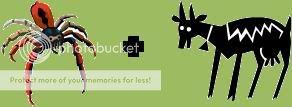
They milk goats who have been genetically combined with spiders to form a super strong, super light weight spider silk material within the milk which is then used for a variety of applications. The goats also have been altered to lactate at an earlier age to speed production.  Because, darn it, who wants to wait that long for the spidergoats to lactate?

Here's a quote from the Nexia Biotechnologies homepage.  Read it word by word, slowly, and chew on each morsel.  Now spit it out... quickly! Rinse.  Repeat.

BioSteel® is Nexia's recombinant dragline spider silk program and is based on using Nexia's transgenic goat technology.

I'm fine through the first three words, except for "BioSteel" and "Nexia".  Now I'm going to translate** the rest of the words in order as it dives deeper into the creepiness:

Recombinant:   Moving and rearranging genes from one place to another.  Not creepy by itself, except that they are talking about rearranging genes, not from one animal to another, but from one major taxonomic classification to another.  This is not species level stuff.  It is kingdom level fiddling. Never a good idea if you ask me.

Dragline:  The larger and stronger of the spider web components.  Used to anchor the rest of the web.  And speaking of anchoring something that shouldn't go adrift, did you just see that whispy thread of common sense float by?

Spider:  Large insect*** with horrible fangs and claws.   That's right, they're combining Shelob (an "evil thing in spider form") with Pan.  That's going to be one messed up flute player.  Tolkien would not be happy.  Nor Hariprasad Chaurasia.

Silk: Technical, jargony mad-scientist term for spider webs. And soy milk.

Program: Plot to destroy the planet by combining wildly divergent life forms such as Spiders & Goats to make BioSteel.  In a few years the "program" will roll out these combos: Slug/Lobster, Porcupine/Bat, and Tick/Whale, and Teletubby/MyLittlePony. 

And: In addition to.  Also.  See what I mean? There's way more ahead, the hits keep coming.

Is:  Current fact. Inevitable, unchangeable, inalterable.

Based:  Grounded.  Founded upon.  C'mon, it's not founded on anything but a rip off of every Marvel Comic plot.  This is a shoe-in for the presitigious "Scientific Experiment Gone Horribly Wrong Award".

On:  Atop of. Over.  Or, if you will, over the top. 

Using: Ingesting large amounts of phychotropic drugs, causing one to: A) Think of the idea in the first place; and B) Think the idea was good.

Nexia:  Acronym for "Never Ending Xperiment In Absudity"

Transgenic:  Creepy craziness crossdressing in the garments of the rational.

Goat: Large hairy insect*** that eats tin cans.  "Goat" is a word, that according to all laws of nature, was never meant to be followed by the next word below:

Technology:  Random and dangerous throw-it-up-against-the-wall-and-see-if-it-sticks experimentation.  Of the type performed by kids who survived the "Hey-Jimmy-let's-mix-all-these-random-household-cleaners-from-under-the-sink-then-light-it-on-fire" episodes of childhood.

Nuff said.  Poll closed.


The Fine Print

*Unless Nexia makes really cool, super-strong, super-light backpacking gadgets that lighten my load.  In that case.  I'm all for it!

**Bear in mind that the only translating experience I have is a few years of high school Spanish and a few months of Patagonian charades with my field assistant, Igor, from Santiago.  So if I were a Babel Fish, you should definitely not cram me into your ear canal.  Gregarious mistakes should be expected in any translational work from me.  I'm sure that a genetic engineer is going to correct me on my "recombinant" definition, an arachnologist will "tsk" me for the dragline flub.

***I know they're not insects.  I'm just raising the cackles of the arachnological community.   Nice cackles ya'll!


The Ninth Hour


I just saw a fascinating post about "La Nona Ora" at "Leave the Lights On".   In it, Ginko100 shows a sculpture by Maurizio Catelan of Pope John II that is, well, unusual.  When I first saw the image I thought it wasn't a serious art piece, I'm ashamed to say.  But getting beyond the incongruity of the Pope struck by a meteorite, there's a great spiritual truth captured in the sculpture.  And that is, when  your world crashes around you, the only hope is to cling to the cross.     When the sky falls, heaven does not.  There is a determined intensity in John Paul's expression, as if to say, "A huge chunk of space rock may drop on me, but I will not drop my faith."   
 LaNonaHora,zoom


Now look at the enlarged facial expression of the Pope. Look closely. There's determination, conviction, even stubbornness. GK Chesterton argued that the problem with modern man is not a lack of modesty, but that modesty has fallen on the organ of conviction rather than the organ of ambition.  Looking at the face of the Pope, there is no modesty of conviction.  The grip of his conviction matches the grip on his staff.  The image says, "I know something!"
Now compare the Pope's face with the image I use for this blog: the death mask of Isaac Newton.   The deep brow, clenched mouth, eyes shut tight speak of unrelenting conviction in both faces.  


NewtonLaNonaHora

The Newton image fascinates me, and on some levels terrifies me.  So much of his character bursts from the image.  Doesn't it look like he knows the secrets of the universe, but that he'll never tell?  Even to the grave he carries his secrets.  Doesn't it seem that was plotting the destruction of his enemies Hooke and Leibniz even as the brass casting for the mask was being forged and the grave already claimed him? I think that I would have feared Newton had I known him.  I also get a bit of vertigo when I look at the mask image.  A temporal vertigo. As if I'm looking over a chasm which spans hundreds of years into the past.  Yet across that huge gulf in time, the very intimate details of Newton's face carries like a force.  In the same way that gravity acts across spatial distances, the force of the death mask picture acts across a great arc of time.  I shuddered the first time I saw it.  For years my young son was spooked by the picture  and kind of walked around it like he might a rapid dog. Aren't you a bit afraid that suddenly the eyes will pop open?  

Yes, there's morbidity.  But I think that the intimate and profound impact of a legend present in the picture outweighs the morbidity.  I've always considered Newton from a distance.  But looking at him closely I feel like I've just barged into his workshop at Trinity College and disturbed a critical, complicated and highly sensitive experiment.  Part of the facial expression says, "Get the hell out and shut the door behind you!"  

But now look at the Newton image and consider that this is the man who wrote 1 million words on alchemy.  It is the face of an obsessed alchemist!  His alchemy is extremely complicated, strange and occultic in its form, if not substance.    There's great debate about his intentions in alchemy.  Was he acting in a scientific role and used alchemy as the precursor to modern chemistry? Or did he "buy in" to the mystical/spiritual/occultic aspects of alchemy?    My novel "A Body at Rest" plays with a third hypothesis:  that his obsession was neither  a scientific endeavor nor a traditional "philosopher's-stone-turn-lead-into-gold" activity.   I propose that his alchemy was a coded language used to cloak a conspiracy that he carried to the grave.  The death mask face tells me that he discovered a secret that he, and he alone, shall possess even to death.  But in the novel, the secret finally surfaces.  In the twelfth hour.

You should regularly check out Leave the Lights on for other gems.


Wednesday, January 7, 2009

Cool or Creepy? Stemcell Computing

I'm not opposed to organic computers, per se, but Zii Stemcell Computing crosses the creepy line in my book (mostly because of the magic pixie dust that poofs up from time to time).  Go ahead, "register" for the "updates".  But don't "complain" to me when your "fingers" start "twitching" and you can't get the "high-pitched" "ringing" out of your "ears".

And speaking of lines being crossed, isn't organic computing operating under the same Zeno paradox as Crayon Physics, but approaching the station from the other side of the train tracks?  With the Crayon Physics Paradox, things get very strange the closer "virtual" reality approaches "real" reality.  But organic computing is the mirror image where "real reality"gets stranger as it approaches the virtual, computerized world.  In fact, I'm coining a new paradox that identifies this phenomenon.  Since I can.  And since I wasn't immediately slapped down after my first phrase coinage by the VR community, or the blogging community, or the Crayon Physics community*, or the Big Time International Phrase Coining Commission.  So the approach of the the biological toward the virtual by means of  computer technology integrating into organic life is now officially the SCISYHP NOYARC Paradox.    Those pansies at the BTIPCC are just a bunch of empty-suited bureaucrats anyway.  The last person they went after was Knute Bleegler in 1979 who tried to coin the phrase "More huggy than a hamster".  And even he got off with just a wrist slap and some community service.  So I'm not afraid of them. Bring it on BTIPCC!!!

And without further ado, becuase there's way too much ado in this post, the Cool or Creepy poll:


Update 1/18/09:   Poll closed.  Readers voted this to be "cool".


Fine Print

*Though I did get a teeensy rebuke for what someone interpreted to be spam at the CP Forum. You tell me.  Honestly, I'm not a spammer.  Am I?  Well...am I?  No!  I'm not.  And don't tell me that spamming is like alcoholism where the denial is proof of the disease.  Because, dagnabbit, I'm not a spammer!  I can quit posting to the Crayon Physics forum whenever I want.  It's just that I don't want to stop posting there.  And so what if I happened to mention my blog address in the post?  I hope this label isn't something that forever blots your escutcheon even if you're innocent. Like being labelled a "nose picker"   when all you do is occaissionally scratch the nostril event horizon**.  Or like being called a "dried glue collector" when all you did  in the second grade was scrape the glue off the school desk and put it in a little box in your bottom drawer at home and sometimes admire the really long pieces of dried glue.  Sheesh!  

**I'm also officially coining the phrase "Nostril Event Horizon". Like a black hole, the rim of the nose outside which finger fiddling can be called a scratch, but inside which the finger action cannot escape being drawn in and rightly called a pick. Just be sure to tell people you heard it first on The Secret of Newton... And here's the Google Search screen shot to prove it's original with me.


Nostril Event Horizon Screen Shot


On second thought, scratch that. Don't credit The Secret of Newton.

Tuesday, January 6, 2009

Off Topic: The Existential Rodent


This is a recycled essay that I wrote a few years ago.  It is off topic unless there's a connection to rodent physchology, which is a legitimate scientific field.  No, on second thought, it's just plain off topic.  But there has been overwhelming demand** to bring the essay back for an encore.   So without further ado, I present to you: 


The Existential Rodent

OK, I admit it. We have mice and rats in our basement (years ago it was possums.  At least the critters are getting smaller. In a few years it will be fire ants). The rodents have rapidly gone beyond the novelty phase. Now it's in the death and destruction phase.  For me at least.  My son is a different story.  I go to the store to get traps.  You know, the snap-hard-enough-to-break-your-fingers-if-you-don't-set-them-right devices.  My son, being the big hearted kid that he is, has some reservations about this brand of vermin treatment. So OK, being the big hearted guy that I am, I buy the old fashion snap traps, the old fashion poison and the new fangled "live traps" (catch and release).  I figure, let the critters choose their own fate.

Last night we caught the first victim on a snap trap.  I wish that it was one of the big ugly rats, bug eyed, coarse hair, snouty noses.  But, alas, it was a tiny little mouse.  I admit, cute as anything.  Maybe he was a troubled mouse, didn't want to live, didn't want to be caught in a live trap and set free only to face the torment of living a cute-mouse existence.  Maybe he was taunted by his buddy's for not liking cheese, for not wanting to poop all up and down our basement steps, for not wanting to scurry in our walls when we are in bed and we can't sleep because we hear the pitter patter of little feet.  Maybe. 

Regardless, the mouse chose his fate, and I stand by that conclusion.  My son and I were in the office when we heard a large SNAP in the basement.  The boy wonders what that noise was.  I don't. 

[Warning the following is absolutely true.  Not to say the preceding isn’t true, but just a warning]

 Within the next 60 minutes my son has:

1.    Named the dead mouse “Skruffy”.

2.    Insisted that the mouse have a proper burial, not be thrown into the garbage as I (humanely) suggested.

3.    Written and illustrated a poem to Skruffy.  The poem was actually fairly touching, something to the effect of “You were a cute mouse Skruffy, and though I hardly knew you, I will miss you”.  He signed the poem with he and his mom's name.  The fact that my name was left off of the dedication was not lost on me.  The illustrations on the poem also were heart warming, a big pink heart and a red rose.  I almost started feeling like a first class jerk for not writing an newspaper obituary. Then I snapped to it and remembered the grim task we (I) had with all the rest of his buddies.

4.   My 7 year-old son cried his little heart out over the injustice in the world, wondered why life had to be like this, and asked most questions that Existentialists throughout the ages have savored as their own clever, deep philosophy. 

I tried to make matters better by reminding him of the hornet nest we destroyed last summer. Why? Because hornets are a danger… Remember son, I got stung in the chin?  It hurt!!!!  Sometimes people need to get rid of creatures that are dangerous.  He pleads, “But dad, that mouse is so cute!!!”  I figured it wasn’t time to go into the gory details of rodents’ historic role in the Plague and, recently, Hanta virus.  He was also on the verge of extending sympathy to the dead hornets, which is not a good thing, in my book.

My then-wife played the middle ground in this whole affair.  She was torn because:  1) She hates mice/rats; and 2) she has a big heart and that mouse was so darn cute!  When I left in the morning, my son was preparing a burial ceremony in our back yard.  I figured I’d skip this one because there were still a passel of critters in the basement and if they didn’t choose the live humane trap, then this episode would be repeated.  I feared that we’re due for a sad series of:  my son's short stories (“Squeakers: The Little Mouse that Could”), novellas (“The Short Life and Times of Willie Whiskers”), epic poems (“Ode to Furry Freddy”),  made for TV Hallmark Movies (“Fluffers Come Home”), and musicals (“Gotta Squeak!”).

Life goes on.

-------------

**Demand partly--no mostly--no primarily -- no, only by the author of the essay.

Monday, January 5, 2009

Nicolas Bourbaki: The Greatest Mathematician who NEVER Lived

Nicolas Bourbaki is the greatest mathematician who NEVER lived.  He produced outstanding advances in set theory, algebra, and topology among many others. Bourbaki published 40 volumes of work. Though he waxed and waned, he was a steady contributor for 50 years after the 1930s, especially in France.  But he's never drawn breath or put pencil to paper.  He never existed.

In fact, Nicolas Bourbaki wasn't a mathematician.  He was a conspiracy.

I'm not a mathematician, but I'm interested in math.  And I'm not paranoid, but I'm partial to my share of conspiracies (and I don't care if they are watching me!)  So that makes him my kind of historical figure and, apart from Newton,  Nicolas Bourbaki stands as my favorite math guy. 

He was invented in the 1930's by five students who wanted to rewrite the standard math text under the cloak of secrecy! [Insert the sound of the Twilight Zone here].   They operated for years, publishing under a pseudonym and adopted persona.  They were highly exclusive and had rigorous standards for their approach to their work.   They recruited in secrecy.  The academic community assumed that there was some brilliant, quirky recluse operating in his own bubble and cranking out brilliant work.  Turns out there were a bunch of brilliant, quirky recluses operating in a bubble.  The ruse eventually ran its course and the final Bourbaki publication was in 1983.

The story is much better told at Planet Math.  

Because this appeals to me on so many levels, I fashioned Sir Robin Louis Baack*, the antagonist in my novel "A Body at Rest", after Nicolas Bourbaki*.    In the novel, Sir Robin is the head of an academic secret society bent on destroying Cambridge University.  Oh man, there's going to be some trouble coming from the House of Baack.  Big trouble.


The Fine Print
*Twelve bonus points to you if you figured out that these two are anagrams (leaving out the "sir").   No, wait.  I'm just giving ten bonus points.  I mean, come on!  They have all the same letters in their names, just rearranged...Hey now!  Don't get snippy with me.  I'll knock it down to 8 points.  I will.** 

**I mean it.


Introducing a New Feature: Cool or Creepy?

The Secret of Newton is adding a new item called "Cool or Creepy?". Regular updates will pose the question about technology that pushes the limit, gadgets that raise the hair on your head, pictures that might have a high pucker factor. Your participation in the polls is most welcome. Also, please forward ideas to me that you think would make good candidates for a Cool or Creepy posting.

And the First Inaugural "Cool or Creepy" candidate is the Boston Dynamics Battlefield Quadruped.


Update 1/8/08: Poll closed with creepy winning by a nose.

Sunday, January 4, 2009

The Crayon Physics Paradox: V1,000,001

Here's a thought experiment in response to Assaf of Physically Incorrect, who gave me some good fodder to chew regarding my post "When Virtual Reality Approaches Reality". I agree with Assaf in that there is intrigue in the act of digital creation. Also agreed that virtual reality and reality are different systems.  

I still think, however, that there is something odd that takes place at the boundary between the virtual and the real. It is easiest to wrap my head around it by reducing it to a simple system of single ball drop onto table. If the ideal for virtual reality is to approach reality, then there is a continuum between unrealistic and realistic systems, culminating in an actually real system. Part of this is tongue and cheek, but I'm also genuinely interested in the math of this thought experiment. I suspect that a form of Zeno's Dichotomy Paradox of Motion is at the foundation of this. 

And now the thought experiment. Let's use Crayon Physics.   Let's imagine that the first iteration of the program was crude.  They could digitally create a ball that dropped and hit a table, but the bounce wasn't realistic.  It just bounced up and down repeatedly at the same height, not losing momentum.  Also, if you drew an oblate sphere it still bounced straight up when it landed on a side that, in reality, would clearly send it rebounding at an angle.   It was cool to bounce the Version 1 (v1) ball but not cool enough because it was far from reality.  Version two is vastly improved and a giant step was made to get closer to reality.  The v2 ball lost momentum as it should but the rebound angle wasn't solved.  The V3 Ball took another big step toward reality by adjusting the angle of incidence and reflection.  That was even cooler than v1 and v2.  However, the makers weren't satisfied because it didn't take into account the introduction of wind, air resistance, elasticity of the ball, etc...  So they make V4, V5, V6... each time taking one step closer to reality, and each time the ball drop system increased on the "Cool Factor Scale", albeit at a smaller amount with each iteration.    

Now here's where it gets fascinating to me.  Let's jump ahead to V1,000.  At this time Crayon Physics has become adopted by the Federal Government and there are NSF dollars invested in the project.  The ball drop is now extremely cool and very realistic, in fact the "Cool Factor vs Reality" graph has been changed to a logarithmic scale on both axes.    At V1,000,000 the project goes international.  The Large Hadron Collider project has been abandoned in favor of Crayon Physics.   It is now the BIG SCIENCE project (neglect the corrupting influences of politics and other Big Science inefficiencies and garbage.)  Billions of dollars are spent.   It reaches the point that you are immersed in a 3D holographic VR chamber.  The virtual ball is transmitted though integrated biotechnological circuits into your brain so that you actually feel the temperature, weight and texture of the ball.  Crayon Physics shamed the VR system in The Matrix long ago, way back around V754,982.   Movie stars, literati, dignitaries are paying six figures to "Drop the Ball" because it is so cool.  

Then the funding dries up and the plug is threatening to be pulled on the entire project. (A comet struck the earth, caused global cooling and all the money was diverted to discovering ways of heating up the planet.)

Under tremendous pressure from trade unions, the Prime Minister of the "International Ball Drop Consortium" comes up with a brilliant idea. He figures that since V1,000,000 is so close to reality that nobody will be able to tell the difference if he substitutes a real ball for the virtual one.    And since people are still lining up and paying big bucks to "Drop the Ball" he makes V1,000,001:  a real ball dropped on a real table.  Nobody could tell the difference because the prior version was soooooo realistic.  The V1,000,001 scam went well for a decade and was a closely held secret within the consortium.   The IBDC made millions in revenue (not to mention the endorsements deals!)  

That is, until Snerd Jackely got disgruntled.  Snerd was the Junior Undersecretary to the Sub-Warden of the Security Division of the IBDC (JUSWSD - IBDC) and got passed over for a promotion to become SUSWSD - IBDC.  Oh he was mad!  His revenge?  He turned states evidence and informed the world that the VR ball was in fact real!  After the U.N. tribunals and World Court trials, what was left?    The cool factor of dropping the real ball dropped like a stone.  The "Line of Reality" was crossed.    

Forgive please the drama and tongue-in-cheek of this thought experiment.  Set aside the economics of supply/demand in dropping V1,000,000 versus V1,000,001.  There's calculus in here.  I know it.  And there still lies a paradox and something strange occurs when the limit of reality is approached in smaller and smaller increments.   In fact, I'm going way out on a limb* and coining a new paradox: The Crayon Physics Paradox.  

And, I'm also going to be the first to shorten the paradox name to CPP.  And I'm going to go drop a ball in the kitchen.

Thanks again Physically Incorrect.


Fine Print

*Or I'm exposing my ignorance of an ancient debate in the VR community by naming that which has already been named and elucidated much clearer than above.