Gem from GK Chesterton

"A dead thing can go with the stream, but only a living thing can go against it."

From The Everlasting Man

Showing posts with label A Body at Rest. Show all posts

Thursday, January 8, 2009

The Ninth Hour


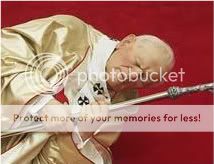
I just saw a fascinating post about "La Nona Ora" at "Leave the Lights On".   In it, Ginko100 shows a sculpture by Maurizio Catelan of Pope John II that is, well, unusual.  When I first saw the image I thought it wasn't a serious art piece, I'm ashamed to say.  But getting beyond the incongruity of the Pope struck by a meteorite, there's a great spiritual truth captured in the sculpture.  And that is, when  your world crashes around you, the only hope is to cling to the cross.     When the sky falls, heaven does not.  There is a determined intensity in John Paul's expression, as if to say, "A huge chunk of space rock may drop on me, but I will not drop my faith."   
 LaNonaHora,zoom


Now look at the enlarged facial expression of the Pope. Look closely. There's determination, conviction, even stubbornness. GK Chesterton argued that the problem with modern man is not a lack of modesty, but that modesty has fallen on the organ of conviction rather than the organ of ambition.  Looking at the face of the Pope, there is no modesty of conviction.  The grip of his conviction matches the grip on his staff.  The image says, "I know something!"
Now compare the Pope's face with the image I use for this blog: the death mask of Isaac Newton.   The deep brow, clenched mouth, eyes shut tight speak of unrelenting conviction in both faces.  


NewtonLaNonaHora

The Newton image fascinates me, and on some levels terrifies me.  So much of his character bursts from the image.  Doesn't it look like he knows the secrets of the universe, but that he'll never tell?  Even to the grave he carries his secrets.  Doesn't it seem that was plotting the destruction of his enemies Hooke and Leibniz even as the brass casting for the mask was being forged and the grave already claimed him? I think that I would have feared Newton had I known him.  I also get a bit of vertigo when I look at the mask image.  A temporal vertigo. As if I'm looking over a chasm which spans hundreds of years into the past.  Yet across that huge gulf in time, the very intimate details of Newton's face carries like a force.  In the same way that gravity acts across spatial distances, the force of the death mask picture acts across a great arc of time.  I shuddered the first time I saw it.  For years my young son was spooked by the picture  and kind of walked around it like he might a rapid dog. Aren't you a bit afraid that suddenly the eyes will pop open?  

Yes, there's morbidity.  But I think that the intimate and profound impact of a legend present in the picture outweighs the morbidity.  I've always considered Newton from a distance.  But looking at him closely I feel like I've just barged into his workshop at Trinity College and disturbed a critical, complicated and highly sensitive experiment.  Part of the facial expression says, "Get the hell out and shut the door behind you!"  

But now look at the Newton image and consider that this is the man who wrote 1 million words on alchemy.  It is the face of an obsessed alchemist!  His alchemy is extremely complicated, strange and occultic in its form, if not substance.    There's great debate about his intentions in alchemy.  Was he acting in a scientific role and used alchemy as the precursor to modern chemistry? Or did he "buy in" to the mystical/spiritual/occultic aspects of alchemy?    My novel "A Body at Rest" plays with a third hypothesis:  that his obsession was neither  a scientific endeavor nor a traditional "philosopher's-stone-turn-lead-into-gold" activity.   I propose that his alchemy was a coded language used to cloak a conspiracy that he carried to the grave.  The death mask face tells me that he discovered a secret that he, and he alone, shall possess even to death.  But in the novel, the secret finally surfaces.  In the twelfth hour.

You should regularly check out Leave the Lights on for other gems.


Monday, January 5, 2009

Nicolas Bourbaki: The Greatest Mathematician who NEVER Lived

Nicolas Bourbaki is the greatest mathematician who NEVER lived.  He produced outstanding advances in set theory, algebra, and topology among many others. Bourbaki published 40 volumes of work. Though he waxed and waned, he was a steady contributor for 50 years after the 1930s, especially in France.  But he's never drawn breath or put pencil to paper.  He never existed.

In fact, Nicolas Bourbaki wasn't a mathematician.  He was a conspiracy.

I'm not a mathematician, but I'm interested in math.  And I'm not paranoid, but I'm partial to my share of conspiracies (and I don't care if they are watching me!)  So that makes him my kind of historical figure and, apart from Newton,  Nicolas Bourbaki stands as my favorite math guy. 

He was invented in the 1930's by five students who wanted to rewrite the standard math text under the cloak of secrecy! [Insert the sound of the Twilight Zone here].   They operated for years, publishing under a pseudonym and adopted persona.  They were highly exclusive and had rigorous standards for their approach to their work.   They recruited in secrecy.  The academic community assumed that there was some brilliant, quirky recluse operating in his own bubble and cranking out brilliant work.  Turns out there were a bunch of brilliant, quirky recluses operating in a bubble.  The ruse eventually ran its course and the final Bourbaki publication was in 1983.

The story is much better told at Planet Math.  

Because this appeals to me on so many levels, I fashioned Sir Robin Louis Baack*, the antagonist in my novel "A Body at Rest", after Nicolas Bourbaki*.    In the novel, Sir Robin is the head of an academic secret society bent on destroying Cambridge University.  Oh man, there's going to be some trouble coming from the House of Baack.  Big trouble.


The Fine Print
*Twelve bonus points to you if you figured out that these two are anagrams (leaving out the "sir").   No, wait.  I'm just giving ten bonus points.  I mean, come on!  They have all the same letters in their names, just rearranged...Hey now!  Don't get snippy with me.  I'll knock it down to 8 points.  I will.** 

**I mean it.


Tuesday, December 23, 2008

Welcome to "The Secret of Newton" Blog from Brian Steele

By education and trade I'm a geologist which makes me a scientist. But I'm not an authority on science though I know a thing or two about rocks. I'm fascinated by history, but not a historian. I am a Christian, but not  a theologian. I am Newton enthusiast but am far from a Newton scholar. I wrote  the novel "A Body at Rest" to pursue my passions in the areas of science, history, faith and the interaction of the three. The only mantle of authority I claim is the history and inner workings of Elyon College, the fictional school I created for the sake of the novel. For matters relating to Elyon I'll accept criticism and correction only from the novel characters themselves, and, since by my keyboard I hold them by the lips, that's not likely to happen.

In all other matters on this blog (religious, scientific, historical) I welcome your input, discussion, dialogue and correction where I stand to be corrected. As I said, my command and understanding of the realm of Elyon is unimpeachable, in all else fire away. From this blog and the novel, I welcome input from Cambridge alumni, Newton devotees, scientists, people of faith and people without faith. All are expected and I hope will be shared with my same passions and intentions to highlight some brilliant subjects, times, places and characters in history. Cheers!

Monday, December 22, 2008

Open Comments for Early Readers of "A Body at Rest"

If you've been given an early copy of my novel "A Body at Rest", here's a place to leave comments, interact with the other readers, shoot spit balls, or hurl rotten vegetables.  No spoilers please.