


I also want to thank the other One Giant Leap contributors:
Arash's World

They all are an essential part of any healthy blog diet.
And for the record, here are the contributions again to "One Giant Leap".
--------------------------------
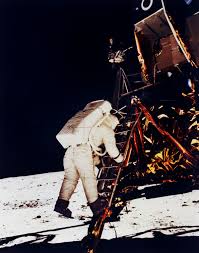
What advancement in thought, technology or discovery pushed science the furthest in one giant leap? This question was posed to some outstanding bloggers for whom I have great respect. And it is your job, dear reader, to vote for which of the following is the "One Giant Leap".
Unless you're from Illinois each person gets one vote, so I ask you to lobby your friends/family/garbage collectors to vote for which scientific advancement is the most important as a single step in history. The poll will be open for 1 week so organize your grass roots, and let the debate begin. When voting you'll need to decide which blogger is most convincing in their "Giant Leap" if there is overlap between submissions.
The blogger who garners the most votes will not only win glory, honor, fame and the respect of their peers, but also 20 Bonus Points and likely assure themselves a top spot on the Bonus Point Leader Board or be able to get fabulous stuff from the Store House O' Prizes. And you, dear reader, will win because you'll be exposed to bloggers who are well worthy of your time to read and follow closely.
So without further ado, I present to you the One Giant Leap candidates and their submissions. The poll follows these submissions.
Rocket Scientist: Information Technology Revolution
I'm going to have to go with the information technology revolution and all that entails. I can't think of anything that has changed the world we live in more than the way we communicate and get/send information. When I think back 100 years (speculatively of course) and the world as it was then and then think back 500 years before that, the difference between 600 and 100 years is not, in my opinion, as profound as the change in the past century. But, more than that, the world my father grew up in is a damn site closer to the world his father grew up in than to the world I grew up in. And mine is much more like his than my daughter's is to mine.
I don't think it's any one thing but the serendipitous combinations of many things like computers and word processing/image processing, and the internet and telephones/instant paging and faxes and email and truly instant access around the world.
You can't keep a secret any more like you used to. Someone with a cell phone camera will be there. You want to know what something is, google and know. You want an opinion by someone in another country. Find one instantly!
Geography is less of a concern than it's ever been. Information can go anywhere, instantly. The world and entertainment for kids today is a completely different world than it was for me and light years from how it was for my grandfather. Good or ill (and I think much of it is good), it sure as heck is different.
Ether Wave Propaganda: Sir Isaac Newton's Principia
If we're talking about a single contribution, and if we measure the "size" of that contribution as a leap that had a very quick effect rather than a cumulative one over all remaining history, I'd probably have to go with Newton's Mathematical Principles of Natural Philosophy. To suggest that astronomical motions could be explained in terms of force acting over time was a massive shift in thinking, and to offer no philosophical explanation of this force (contra Descartes' version of mechanistic natural philosophy, itself a huge contribution) simply doubled down on an already massive contribution.
The feat, one might say, was replicated in 1925 when Werner Heisenberg, Max Born, and Pascual Jordan published their "Three Man Work", which postulated the matrix mechanics version of quantum mechanics. This work suggested that at the universe at its most fundamentally microscopic level could not be mathematically described in any continuous way (as with Newtonian motion), but as a probabilistic and immediate succession between distinct states: the original "quantum leap". They then doubled down (really in 1927 with the so-called "Copenhagen Interpretation" of quantum mechanics) by asserting that there was no underlying but undetectable reality causing the transition from state to state. Only what could be observed could be considered real.
Leave the Lights On: Heliocentrism
I'm going to go with the shift that occurred around the time of the Scientific Revolution in which scientists stopped trying to pigeonhole the universe to their ideas and instead began to described it the way they observed it. I am specifically thinking of the shift from the ancient Aristotelian idea of heavenly bodies circling in shells of aether (which was never able to explain retrograde motion no matter how hard astronomers tried) to planets in elliptical orbits around the sun. This is not the discovery of any one scientist (Copernicus, for example, was the first heliocentrist, but he still believed in spheres of aether), but rather a larger-scale shift in thinking.
At one time, philosophy came up with ideas of how the universe "should be" according to the current understanding of God, and science tried to show how the universe proved that understanding of God. After this shift, scientists observe how the universe is, leaving the philosophers and theologians to work out how it affects our understanding of God.
Newton's Ocean: Mass Conservation in Chemical Reactions
OK so the giant leap has to "advance a field of science" by the hugest amount. I'm going to interpret this quite literally. So I could go after the father of the field of evolutionary biology but that's too obvious. How about the father of chemistry, Antoine Lavoisier, who in 1789 came up with the principle that mass is conserved in a chemical reaction. This led to the whole idea of chemical constituents combining with each other without themselves changing. Not only did this transform (no pun intended) alchemy into the scientific field of chemistry, but it paved the way for Dalton to come up with his atomic theory, and the idea that chemistry involves atomic elements of different weights combining in simple proportions.
Wikipedia seems to imply that Lavoisier really had to keep his unpopular job as a tax collector in order to fund his scientific research. As a result, he was guillotined during the French revolution. So it has always been hard to keep your head while trying to fund those giant leaps.
The Deeps of Time: Greek Philosophical Rationality and the Christian Faith
My first thought is to second the first suggestion, the computer revolution. The progress of scientific knowledge, at least in the total body of scientific facts known, in the last century has been exponential, based largely on the computer. Not only does computer technology allow a wider dissemination of knowledge (like the printing press), it also helps in the processing of that information. In everything from genetics to cosmology, sheer number-crunching and the ability to simulate complex systems has advanced science tremendously.
I'll offer another suggestion, though, in the interests of provoking thought. Readers of my blog know that I place an emphasis on the interaction between philosophy and science. Science itself isn't even possible without a prior belief in the intelligibility of the universe and a trust in reason to be able to investigate it. Historians have noted that modern science is a distinctly Western venture, and Western civilization is at its heart based in two things: Greek philosophical rationality and the Christian faith. Those two facts are related, I believe. It is the Christian belief that God made a rational, purposeful universe and the tools of classical philosophy ("baptized" by Christan thinkers like Augustine and Aquinas) that have made science bloom in Christian culture in ways that it couldn't in other intellectual paradigms.
Nested Universe: Heliocentrism
I'll suggest that Copernicus' theory that the Sun is at the center of our Solar System is the greatest leap in the history of science.
Not only did this theory redefine astronomy, his work is seen by many as the starting point of the Scientific Revolution itself, and led to significant advances in a number of the Sciences. Understanding that our world does not hold a special place in the universe was a truly revolutionary change, and one that sparked a radically new way of thinking about our world and ourselves.
Arash's World: The Gutenberg Press
If thinking about inventions, I would say that Gutenberg's invention of the printing press was a giant leap in pretty much all the areas one can think of.
It caused a social and economic revolution as education became more accessible to laypeople and was not only the domain of the church.
It was an information or communication revolution (and I think the Internet, with all due respect, is simply its follow-up, sequel or logical consequence).
All this had enormous impact on religion, government and brought about a changing and more receptive mentality. It brought about more accurate geographical information through actualized maps.
Various other academic disciplines evolved and spread rapidly through books. In other words, knowledge was finally, at least theoretically, available to all. Without the printing press I would venture to say that we would not be where we are today.





 Posts
Posts

