


Then burn thy Epicycles foolish man;Break all thy spheres and save thy head.Faith needs no staffe of flesh, but stoutly canTo heav'n alone both go and leade.Excerpt from "The Temple", George Herbet, 1638
Epicycles are an example to me of a glorious error. Most errors in life are typically embarassing, ugly or cringe-worthy (dropping the ice cream off the cone, stepping in a dog pile, calling an old friend by the wrong name). But the constructs of epicycles (the geocentric attempt at explaining retrograde planetary motion) are gorgious and stunning. Wrong, yes, but beautiful. Even poem worthy! Thank you very much Mr. Herbet.
Prior to a heliocentric model of the cosmos, astronomers had a very difficult time explaining the wandering (retrograde) motion of the planets in the sky with respect to other stars. The wriggle and wobbly path that planets took did not neatly conform to the perfect, spherical ideals of geocentrism. Enter epicycles.

In order to fit the wandering retrograde motion of a planet into the concept that the heavens are perfect and, therefore, in perfectly circular orbits, Ptolemy assigned planetary motions to smaller circles attached to a larger circle. As shown in the animation above from the Natural Sciences 102 course at the University of Arizona, this epicycle motion does, in fact, yield circular motions with a wiggle to an observer on earth. The problem is that epicyle-calculated planet motions do not precisly match accurate observations.
But it is such a beautiful error. This 15th century astrolabe makes me practically wish for epicycles to be true, just so these instruments could be in common use and production today.
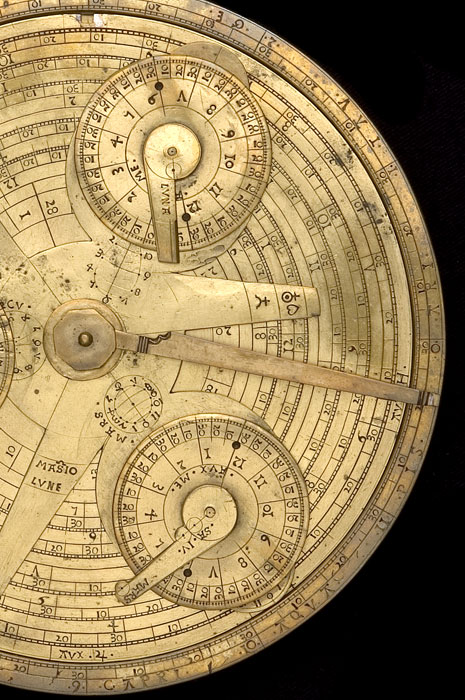
15th Century Astrolabe, from the Museum of the History of Science, Oxford.
When a simple epicycle did not accurately describe retrograde motion then epicycles were placed into epicycles. And the erroneous system became complicated. Wonderfully so. Ptolemy's Almagest in which he outlines his concept of epicycles is fantastically detailed, highly analytical and gorgeously wrong.
I hold a weepy nostalgia for compendia. And certainly I do for the epicycles and this astrolabe. Not for the error of the system, but for the beauty of the error.


 Posts
Posts

