Gem from GK Chesterton

"A dead thing can go with the stream, but only a living thing can go against it."

From The Everlasting Man

Showing posts with label Geology. Show all posts

Thursday, February 26, 2009

Geologists' 100 Must See List (Updated)


Geotripper has started a geology-oriented 100 things meme. Thing's I've done are in bold. Follow along and keep score for yourself.

1. See an erupting volcano.

2.
See a glacier. [More glaciers in the North Cascades than you can shake a stick at. The Winthrop Glacier on the north side of Mt. Rainier is IMHO the most dramatic with a huge, yawning mouth at its base that belches out a massive sub-glacial river.  Falling rocks echo across the valley.  Geology in action that is just jaw dropping.]

3.
See an active geyser such as those in Yellowstone, New Zealand or the type locality of Iceland.

4. Visit the Cretaceous/Tertiary (KT) Boundary. Possible locations include Gubbio, Italy, Stevns Klint, Denmark, the Red Deer River Valley near Drumheller, Alberta.

5.
Observe (from a safe distance) a river whose discharge is above bankful stage. [Nooksack River, WA]

6. Explore a limestone cave. Try Carlsbad Caverns in New Mexico, Lehman Caves in Great Basin National Park, or the caves of Kentucky or TAG (Tennessee, Alabama, and Georgia).

7. Tour an open pit mine, such as those in Butte, Montana, Bingham Canyon, Utah, Summitville, Colorado, Globe or Morenci, Arizona, or Chuquicamata, Chile. [The Mesquite Gold Mine in southern California. A pit large enough to see from space. Also the biggest Tonka trucks I've ever seen.]

8. Explore a subsurface mine. [At a tourmaline mine in southern California I saw a gem pocket being cleaned out with gorgeous watermelon tourmalines. Drool soaked my shirt through.]

9. See an ophiolite, such as the ophiolite complex in Oman or the Troodos complex on the Island Cyprus (if on a budget, try the Coast Ranges or Klamath Mountains of California). [The ophiolites in the San Juan Islands of Washington are a great low budget alternative too if you can't cobble together the bus fare to Oman.]

10. An anorthosite complex, such as those in Labrador, the Adirondacks, and Niger (there's some anorthosite in southern California too).

11. A slot canyon. Many of these amazing canyons are less than 3 feet wide and over 100 feet deep. They reside on the Colorado Plateau. Among the best are Antelope Canyon, Brimstone Canyon, Spooky Gulch and the Round Valley Draw. [Box Canyon on the south side of Mt Rainier is spectacular.]

12. Varves, whether you see the type section in Sweden or examples elsewhere. [Some glaciolacustrine varves in Island County, WA].

13. An exfoliation dome, such as those in the Sierra Nevada [I climbed the 5-pitch "Central Pillar of Frenzy" on Cathedral Spire across from El Cap.]

14. A layered igneous intrusion, such as the Stillwater complex in Montana or the Skaergaard Complex in Eastern Greenland.

15. Coastlines along the leading and trailing edge of a tectonic plate (check out The Dynamic Earth - The Story of Plate Tectonics - an excellent website). [I live on the leading edge of the North American Plate as it overrides the Juan de Fuca plate]

16. A gingko tree, which is the lone survivor of an ancient group of softwoods that covered much of the Northern Hemisphere in the Mesozoic. [The new Art and Children's Museum in Bellingham has a Gingko tree. Yeahh!]

17. Living and fossilized stromatolites (Glacier National Park is a great place to see fossil stromatolites, while Shark Bay in Australia is the place to see living ones) [I've seen the fossilized variety, 1/2 credit.]

18. A field of glacial erratics. [Lots in the Sierra Nevada.]

19. A caldera [Massive caldera in Mammoth California, and Yellowstone for the "super volcano"].

20. A sand dune more than 200 feet high.

21. A fjord.

22. A recently formed fault scarp. [I worked on a survey crew as an undergrad, measuring displacements along active faults.]

23. A megabreccia.

24. An actively accreting river delta.

25. A natural bridge.

26. A large sinkhole.

27. A glacial outwash plain.

28. A sea stack.

29. A house-sized glacial erratic. [Sierra Nevada]

30. An underground lake or river.

31. The continental divide.

32. Fluorescent and phosphorescent minerals. [Not "in the wild" but plenty in my petrology/mineralogy classes.]

33. Petrified trees.

34. Lava tubes.

35. The Grand Canyon. [I'm ashamed I haven't been to the Grand Canyon. My good friend Gary has told me that I'm not worth my salt as a geologist until I see the GC. Sigh.]

36. Meteor Crater, Arizona, also known as the Barringer Crater, to see an impact crater on a scale that is comprehensible.

37. The Great Barrier Reef, northeastern Australia, to see the largest coral reef in the world.

38. The Bay of Fundy, New Brunswick and Nova Scotia, Canada, to see the highest tides in the world (up to 16m).

39. The Waterpocket Fold, Utah, to see well exposed folds on a massive scale. [1/2 credit again on this one. I haven't seen Waterpocket, but the folds of Poleta in the White Mountain Range are terrific.]

40. The Banded Iron Formation, Michigan, to better appreciate the air you breathe. [I haven't the BIF in place, but I have a terrific chunk sitting on my desk. It is a gorgeously laminated rock.]

41. The Snows of Kilimanjaro, Tanzania.

42. Lake Baikal, Siberia, to see the deepest lake in the world (1,620 m) with 20 percent of the Earth's fresh water.

43. Ayers Rock (known now by the Aboriginal name of Uluru), Australia. This inselberg of nearly vertical Precambrian strata is about 2.5 kilometers long and more than 350 meters high.

44. Devil's Tower, northeastern Wyoming, to see a classic example of columnar jointing.

45. The Alps.

46. Telescope Peak, in Death Valley National Park. From this spectacular summit you can look down onto the floor of Death Valley - 11,330 feet below.

47. The Li River, China, to see the fantastic tower karst that appears in much Chinese art.

48. The Dalmation Coast of Croatia, to see the original Karst.

49. The Gorge of Bhagirathi, one of the sacred headwaters of the Ganges, in the Indian Himalayas, where the river flows from an ice tunnel beneath the Gangatori Glacier into a deep gorge.

50. The Goosenecks of the San Juan River, Utah, an impressive series of entrenched meanders.

51. Shiprock, New Mexico, to see a large volcanic neck.

52. Land's End, Cornwall, Great Britain, for fractured granites that have feldspar crystals bigger than your fist.

53. Tierra del Fuego, Chile and Argentina, to see the Straights of Magellan and the southernmost tip of South America.

54. Mount St. Helens, Washington, to see the results of recent explosive volcanism. [With a bonus vial of ash my Grandma sent me after it erupted. See my post on "The Persistence of Life" about the recovery of Mount St. Helens.]

55. The Giant's Causeway and the Antrim Plateau, Northern Ireland, to see polygonally fractured basaltic flows.

56. The Great Rift Valley in Africa.

57. The Matterhorn, along the Swiss/Italian border, to see the classic "horn".

58. The Carolina Bays, along the Carolinian and Georgian coastal plain

59. The Mima Mounds near Olympia, Washington. [Kinda creepy when you see these. But I love the 'giant gopher' theory.]

60. Siccar Point, Berwickshire, Scotland, where James Hutton (the "father" of modern geology) observed the classic unconformity. [I've visited the equivalent contact on the Isle of Arran.]

61. The moving rocks of Racetrack Playa in Death Valley.

62. Yosemite Valley

63. Landscape Arch (or Delicate Arch) in Utah

64. The Burgess Shale in British Columbia

65. The Channeled Scablands of central Washington. [The story of J. Harlen Bretz is a must read for the scablands. I highly recommend "Bretz's Flood" for laymen and geologists alike.]

66. Bryce Canyon

67. Grand Prismatic Spring at Yellowstone

68. Monument Valley

69. The San Andreas fault [I would add the town of Parkfield as a must see for the SA fault]

70. The dinosaur footprints in La Rioja, Spain

71. The volcanic landscapes of the Canary Islands

72. The Pyrennees Mountains

73. The Lime Caves at Karamea on the West Coast of New Zealand

74. Denali (an orogeny in progress)

75. A catastrophic mass wasting event [The Hope Slide in southern British Columbia was an enormous event]

76. The giant crossbeds visible at Zion National Park

77. The black sand beaches in Hawaii (or the green sand-olivine beaches).

78. Barton Springs in Texas

79. Hells Canyon in Idaho

80. The Black Canyon of the Gunnison in Colorado

81. The Tunguska Impact site in Siberia

82. Feel an earthquake with a magnitude greater than 5.0. [I grew up in California. 'Nuff said.]

83. Find dinosaur footprints in situ.

84. Find a trilobite (or a dinosaur bone or any other fossil)

85. Find gold, however small the flake.

86. Find a meteorite fragment

87. Experience a volcanic ashfall

88. Experience a sandstorm [San Juaqin Valley, zero visibility on the freeway, dust filtering in the truck. Pretty scary.]

89. See a tsunami.

90. Witness a total solar eclipse.

91. Witness a tornado firsthand.

92. Witness a meteor storm, a term used to describe a particularly intense (1000+ per minute) meteor shower

93. View Saturn and its moons through a respectable telescope.

94. See the Aurora borealis, otherwise known as the northern lights. [In a rare event I saw the Aurora from Washington state in the late 1990's. Unusual for them to be visible so far south.]

95. View a great naked-eye comet, an opportunity which occurs only a few times per century. [Hale-Bopp in 1997]

96. See a lunar eclipse.

97. View a distant galaxy through a large telescope

98. Experience a hurricane.

99. See noctilucent clouds

100. See the green flash

I score a 43, not too shabby.  I don't travel internationally enough to see some of these other gems.

I'd like to know where you score for this list. As an incentive to show off, I'll give you 2 bonus point for every 10 items you've seen on the list. Go on, do some bragging!

Also, I'm curious about what you think is missing. I'll add a few:

  1. A kimberlite pipe, not necessarily diamond-bearing. [I collected a sample of kimberlite from Kentucky. Not the friendliest place to go rock hounding. 'Nuff said.]
  2. Pegmatite insitu with "honkin' crystals"
  3. Turbidite sequences.
  4. Flint Ridge in Ohio, source of much of the Native American arrowheads east of the Mississippi.
  5. Soak in a natural hot spring.
  6. Sand boils from liquefied soils after an earthquake.
  7. Glacially striated rock outcrops


Thursday, February 5, 2009

pL: The Persistence of Life


Last week somebody who was  important in my life passed away.  Among the swirling emotions attendant to funerals I've been thinking of life: its persistence, its fragility. This is the first of two companion pieces that looks at these thought lines, both striking in their own right, and even more so in apposition. 

This post takes up the first theme: life is unbelievably persistent. I'd like to look at the persistence of life from an unusual perspective*: the partial pressure of life.  Since the readers of TSON have already established the importance of semantics, let me define my terms.  The partial pressure of life can be thought of as the force that moves life from areas of high concentration to low concentration.  Not "Life Force" as in a nutritional drink, nor a Star Wars type force that lets Luke be a hero even though he starts out as a whiny little punk**.  Neither am I thinking about "life force" as a concept of spiritual energy.  

I'm using "partial pressure of life" in a similar manner that physicists talk about the partial pressure of dissolved   gases in a liquid.  Dissolved gases move from from areas of high partial pressures to low partial pressures.  I argue that the persistence of life stems from an analogous function (not identical, but analogous).  Life itself has a partial pressure and with often unrelenting, unstoppable force moves from areas of high concentration to low.  I'll shamelessly borrow from physics and refer to the partial pressure of life as pL (similar to pH, which is the partial pressure or activity of hydrogen dissolved in a fluid).   

OK, terms better defined, let's look at the persistence of life.  First, life has absolutely and completely blanketed the earth.   From the highest mountain to the deepest cavern.  Land, sea and air.  After learning about extreme life forms such as thermophiles, acidophiles, alkaliphiles, halophiles (and a whole other grocery isle of extreme "-ophiles") I'm more suprised to find a place where there isn't a form of life.

Of course, life is much more concentrated near the equator according to a number of metrics (diversity of species, number of individuals) and decreases toward the polar regions.   Using the digital equivalents of crayons, the partial pressure of life (pL) across the earth might be charted like this.


So the first thought for the persistence of life is from its geographic abundance.  Along the equator, where the earth receives the most sunlight exposure, the partial pressure of life is highest.   The number of species and variety is staggering (just in insects alone!).  Yet even at the poles, which have extreme temperature fluctuations and low amounts of nutrients, micro and macro psychrophilic*** life is abundant, though with a lower pL than the equator.    It would seem that the high pL gradient inexorably forces life from the equator to the poles.

In some cases there is an actual push from the areas of higher pL to lower pL.  Life is persistent because it fills voids.  Mount St. Helens is an excellent example of this.  On May 18th, 1980 the volcano erupted catastrophically, devastating over 200 square miles of wilderness.   It was a massive loss of life (both human and non-human) and within minutes the pL plummeted to near zero within the blast, avalanche and pyroclastic flow zone.  Yet because there was a drastic gradient in pL between the mountain and surrounding areas, life returned and persisted.   From both animal and plant re-colonization, life has returned to Mount St. Helens.  Life pushed from the high partial pressures surrounding the mountain into the void of the blast area.   

When describing the distribution of mountains and relief on the ground we use topographic lines and contours which are lines of equal elevation.  When describing the distribution of weather phenomenon we use both isotherms (lines of equal temperature) and isobarics (lines of equal barometric pressure).  When describing the devastation of Mount St. Helens, it is instructive (though not necessary) to use isobiotics**** (lines of equal pL).  If you would bear with me an another simple diagram, an isobiotic map after the blast would look something like this.


Even in a volcanic blast zone with, for all practical purposes, the annihilation of life, the steep gradient in the pL ultimately drove life in to fill the void at Mount St. Helens with both macro and micro-organism. The mountain hasn't fully recovered from the eruption. But it will.  Just as it has in millenia past.  Why?  Because life is shockingly resilient.

And Mount St. Helens is only a small volcano.  If you've been to eastern California, you know the stunning beauty of the Owens Valley.  If you haven't been, you must put it on your "List O' Amazing Places to Go".  Mt. Whitney and the Sierra Nevada are on the west and the White Mountains are on the east side of the valley. Drop dead gorgeous.  And yet, beginning about 30 million years ago, before the tallest mountains in the continental U.S. formed, everything did drop dead.  In his outstanding book Basin and Range, John McPhee tells it best:

Up through perhaps a hundred fissures, dikes, chimneys, vents, fractures came a violently expanding, exploding mixture of steam and rhyolite glass, and, in enormous incandescent clouds, heavier than air, it scudded across the landscape like a dust storm.  The volcanic ash that would someday settle down on Herculaneum and Pompeii was a light powder compared with this stuff, and as the great ground-covering clouds oozed into the contours of the existing landscape they sent streams hissing to extinction, and covered the stream beds and then the valleys, and--with wave after wave of additional cloud--obliterated entire drainages like plaster filling a mould.  They filled every gully and gulch, cave, swale, and draw until almost nothing stuck above a blazing level plain.  Needless to say, every living creature in the region died.  Single outpourings settled upon areas the size of Massachusetts, and before the heavy ash stopped flowing it had covered twenty times that.  Moreover, it was hot enough to weld...'When you bury a countryside in that much rock so hot it welds, that is the ultimate environmental catastrophe'.

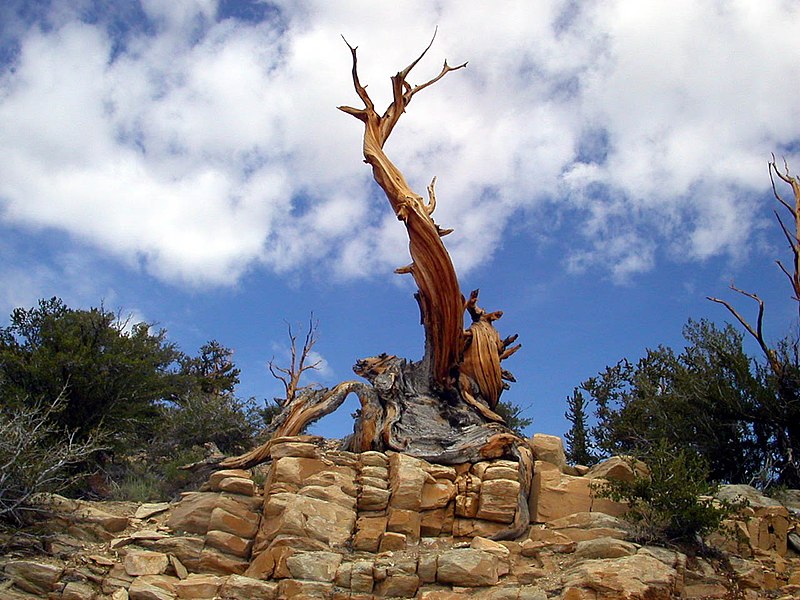
Yet life now persists in the Basin Range--no, teems.   In fact, what is among the world's oldest living organisms, the 5,000 year old "Methuselah" Bristle Cone Pine tree, sits atop White Mountain along the Owens Valley.  Life not only prevailed, it's doing a funky chicken dance in the end zone. The partial pressure of life, applied over time can exert enormous force against even the most catastrophic conditions.  Ever forcing it's way down-gradient from "life" to "non-life". Here's a picture of a Bristle Cone Pine on White Mountain.


I love to backpack, especially in alpine wilderness.  I'm always stunned when I see a tree growing out of a hairline fracture of a rock like this.  This tree and its heirs (life) will likely prevail over the rock (non-life).  It's roots will dig deeper into the fissure and extend to depths of the rock where there is no life.  The roots will grow and ultimately crush the rocks into fragments.  Plants are an enormous and powerful erosional force, helping to reduce mountains to rubble (which is why JRR Tolkien had it exactly right in Lord of the Rings when the tree Ents attacked the fortress of Isengard and destroyed it's rocky reaches).

Though replicated on a smaller scale than the Basin and Range volcanism, the persistence of life is also on display at the Bikini Atoll in the south Pacific where 23 nuclear bombs were tested between 1946 and 1958. While residual radiation still persists, sea life has returned in abundance (including scuba divers), moving down the pL gradient from surrounding areas unaffected by the nuclear blasts.  It will continue to recover over time with life again trumping non-life.   

I'm also fascinated by the persistence of life throughout geologic time.  Newton's Ocean has a great post about telomerase and certain genes that appear to be immortal.  Also look at some cyanobacteria, such as stromatolites (pictured below), that are found both in the rock record dating back about 3 billion years ago and in modern day Australia.


Stromatolites (and other "living fossils") survived catastrophes that make the Bikini Atoll and even the Basin and Range volcanism seem like sand box playtime.  Consider the Permian/Triassic extinction about 250 million years ago where estimates of specie extinction rates are estimated to be between 70-90% of all marine life.  Likely tied to a planetary impact of sorts (asteroid, comet, etc..), the P/T event also wiped out a massive percentage of land-based species.   Another massive extinction occurred at the close of the Cretaceous about 65 million years ago, also likely related to planetary impact.

It becomes evident that pL gradients aren't operable just geographically, because when you look at the geologic record, you see the partial pressure of life acting across temporal gradients.  (I know that this is becoming a bit Rube Goldberg-ish, but it is my prerogative to make something simple more complex than it needs to.)

Extinction charts can be read as partial pressure of life charts (pL vs time).  If there is one thing that is explicitly clear from my study of geology, it is that "life" extends into "non-life" across time. Conditions change (often radically and catastrophically), eliminating a large portion of life, creating a steep pL gradient, then life moves down gradient and fills the void.

Looking forward, I believe the persistence of life is displayed as humans pursue space travel. There's an enormous partial pressure of life on earth adjoining a very low partial pressure of life in the rest of the solar system.  Life is bound to expand into the non-life of space.   

I'd like your thoughts on other examples of the persistence of life.  I know I've just scratched the surface*****.  Also 10 bonus points to the math whizz who comes up with a cool analysis for the partial pressure of life over time or space using calculus.  It starts with  dpL/dt or dpL/dx, now you do the rest if you want the BPs. 

For everybody clamouring that life is fragile (and I know you're out there... lurking!) that will covered in my forthcoming companion post.  For now, just sit and ponder the persistence of life.  Ahhh.....


The Fine Print
*It's unique to me either because I'm too lazy to look exhaustively elsewhere, or because this truly is an new perspective.  Perhaps I'll have Bob of Blackholes and Astrostuff do some digging.  He did after all assure me that my "nostril event horizon" phrase is unique.  And that's good enough for me.

**The "whiny little punk" characterization of Luke is unassailable.  Just watch the original movie (Episode 4 if you want to be technical).  Listen to him say, "But I wanted to go to Tarshi Station for some power converters" and you'll agree.  

***Of course I didn't know this word all by myself.  I found it like everybody else finds stuff.  And no, not the World Book Encyclopedia on my bookshelf.


****Bob, I'll need your help here also to confirm that nobody has coined this phrase.  Yes, I know, I'm in a bit of a slothful mood.   

*****Hey!  Look what I found beneath the surface... life!!!